My name is MORITA Yoko, a disciple of Chief Priest IKEGUCHI.Some of you may have seen me around the temple. I would be delighted to have more opportunities to connect with you all. I studied Buddhism for six years at university and graduate school, focusing on Buddhist literature. From that perspective, I would like to share my thoughts on the topic of this article — the Ojuya (Ten Nights Ceremony). This is my first article. I hope you enjoy it!
What Is the Ojuya?
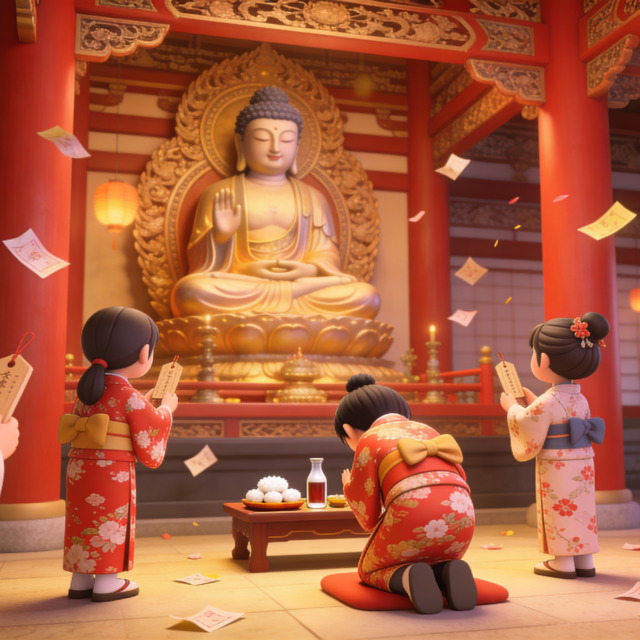
At Ryuganji Temple, we hold the Ojuya service every November. So, what exactly is the Ojuya? Let’s look at its origins and meaning.
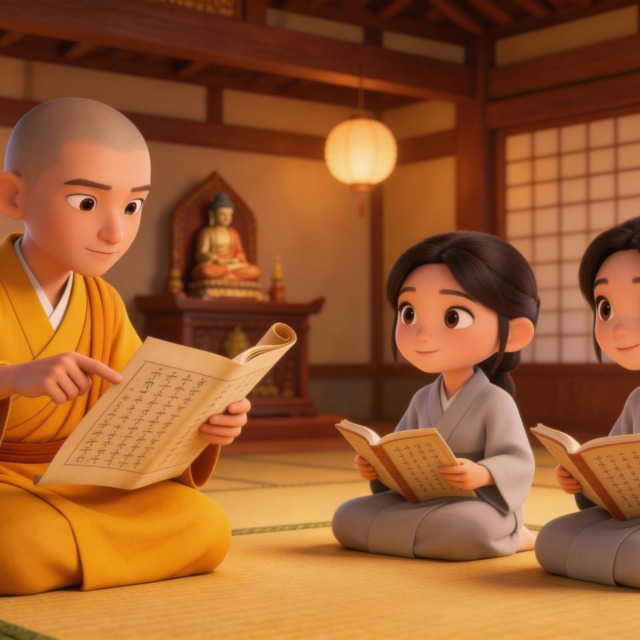
The Ojuya is a Buddhist ceremony in the Jōdo (Pure Land) sect tradition, originally conducted over ten days and ten nights of chanting the nembutsu (“Namu Amida Butsu”).
Its basis lies in a passage from The Immeasurable Life Sutra (Muryōjukyō), which states:
“If one practices good deeds for ten days and ten nights in this world, it surpasses performing good deeds for a thousand years in other Buddha-lands.”
In ancient times, this service was held from the 5th to the 15th day of the 10th month of the lunar calendar (now roughly November 5–15). Today, it is often shortened to three days or even one day. The first Ojuya service is said to have been held at Shin nyo-do (Shinshō Gokurakuji Temple, a Tendai temple in Sakyo Ward, Kyoto), and from there it spread widely to temples of the Jōdo sect throughout Japan.
In essence, performing the Ojuya in this world is believed to bring immeasurable merit and blessing — it is an especially virtuous and precious practice.
A Divine Message During the Ten Nights Ceremony
Here’s the story behind the origin of the Ojuya at Shin nyo-do.
During the Muromachi (1336-1573) to Azuchi–Momoyama (1568-1600) period, there lived a man named ISE Sadakuni, who served the shogunate government. The ISE family traditionally held official positions overseeing litigation concerning the shogunate’s finances and territories.
Sadakuni, troubled by the impermanence of the world, secluded himself at Shin nyo-do and devoted himself to chanting the nembutsu, preparing to renounce lay life. Just as he was about to shave his head and take monastic vows, a venerable monk appeared to him in a dream and told him to abandon the idea of ordination. The next day, his elder brother Sadatsune fell from political favor, and Sadakuni unexpectedly inherited the family headship. Overjoyed by this turn of events, he performed seven days and nights of nembutsu in gratitude at Shin nyo-do — and this is said to be the beginning of the Ojuya ceremony.
In Summary
The Ojuya reminds us of the profound merit that comes from sincere practice. The Immeasurable Life Sutra, on which this ceremony is based, is one of the three principal scriptures of the Jōdo sect (along with The Visualization of Immeasurable Life Sutra and The Amida Sutra).
I hope to continue cherishing and learning from the teachings found within these scriptures. Since last year, I myself have taken part in the Ojuya at Ryuganji. Like Sadakuni, I secretly hope that one day, through this ceremony, I too might receive a divine message.



No comments yet.